
MLS listing reading guide
How to Read MLS Listings Without Missing Key DetailsShort answer: Read an MLS listing in layers. First confirm status, list date, address, property type and price. Then review measurements, rooms, parking, lot, age, taxes, strata or other fees, inclusions, exclusions, occupancy and remarks. Treat every field as a lead for verification rather than a warranty. Ask your representative for current status, source documents, disclosure obligations, title and strata information, and qualified inspections before relying on a material fact.
A listing compresses a complex property into structured fields, photographs and marketing remarks. Those elements help a buyer search, but they can be incomplete, estimated, outdated or defined differently across systems. Reading carefully means noticing both what is present and what still needs proof.
This guide focuses on buyer research and questions. It does not claim a listing is available, interpret a contract or replace licensed real-estate, legal, inspection, mortgage, insurance or tax advice.

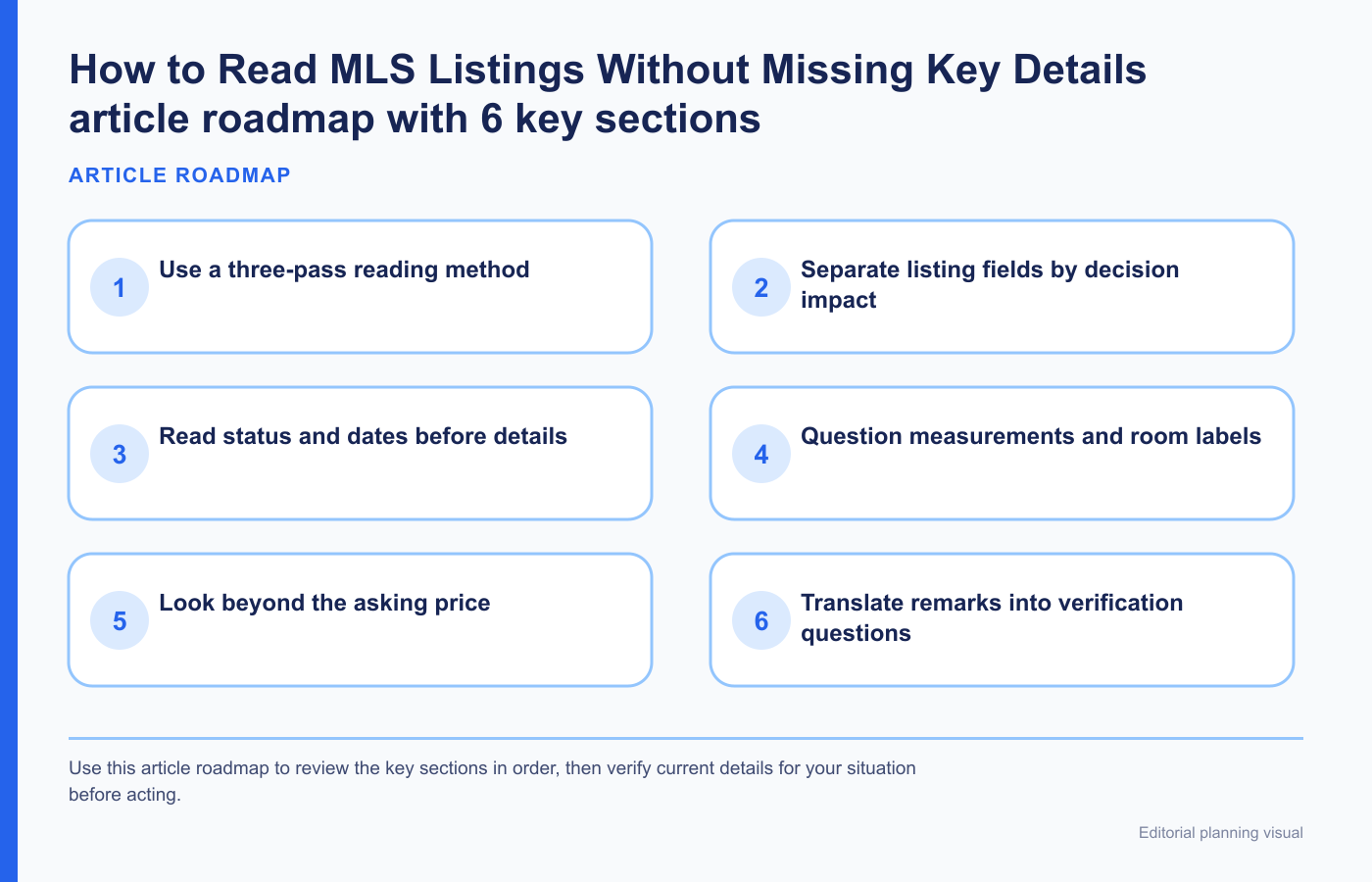
- Use a three-pass reading method
- Separate listing fields by decision impact
- Read status and dates before details
- Question measurements and room labels
- Look beyond the asking price
- Translate remarks into verification questions
- Turn the listing into a buyer research file
- Keep a verification and decision record
- Common mistakes to avoid
- Frequently asked questions
- Take the next step
Use a three-pass reading method
On the first pass, decide whether the broad location, property type, price range and essential features fit. On the second, read every structured field and remark, noting definitions and blanks. On the third, list facts that affect value, use or offer terms and identify the document or professional needed to verify each.
Save the listing date and retrieval time. Status, price and remarks can change, and an old saved page is not current evidence.
Separate listing fields by decision impact
| Field group | Read for | Verify with |
|---|---|---|
| Status and dates | Availability and market history | Current licensed-system update |
| Property facts | Type, tenure, age, size and rooms | Records, measurements and documents |
| Land and parking | Lot, access, stalls and restrictions | Title, survey, strata and site review |
| Costs | Taxes, fees, utilities and inclusions | Current statements and contracts |
| Remarks | Seller and agent descriptions | Independent verification |
Read status and dates before details
Confirm whether the property is active, conditionally sold, pending, withdrawn or otherwise unavailable under the local system. Ask when the status was last updated and whether showing or offer instructions have changed. List price is an asking position, not a valuation or prediction.
BC Financial Services Authority publishes a home-search resource explaining the role of a real estate professional and property search. Use current professional information for a live decision.
Question measurements and room labels
Check whether dimensions are interior, exterior, approximate or supplied by another source. Room names can reflect current use rather than legal classification. A finished-looking area may raise questions about permits, ceiling height, egress, heating or strata approval.
Do not calculate renovation or furnishing decisions from listing dimensions alone. Request the measurement standard, floor plan and source, then verify critical dimensions in an appropriate manner before conditions are removed.
Look beyond the asking price
Review property taxes, strata or maintenance fees, included services, special assessments, utilities, insurance implications, rental or age restrictions and immediate maintenance. Confirm the relevant period and supporting statement. A monthly fee can change and may not cover every expense.
Financing qualification and affordability require current advice. The Financial Consumer Agency of Canada home-buying guidance discusses budgeting and purchase costs at a general level.
Translate remarks into verification questions
Words such as updated, spacious, quiet, legal, permitted, income-generating or future potential should trigger questions: what work was done, when, by whom, with which permits and based on which authority? Photographs can be staged, edited or taken with wide-angle lenses.
Ask whether fixtures, appliances, storage, parking, furnishings or equipment are included, excluded, rented or subject to contracts. Only the final written agreement and supporting documents should control a transaction.
Turn the listing into a buyer research file
- Save the current listing and timestamp.
- Highlight must-have facts and missing fields.
- Ask for current status and documents.
- Compare public, title, strata and seller information as appropriate.
- Arrange qualified inspections and specialist review.
- Confirm financing and insurance fit.
- Put material representations and conditions in writing.
- Recheck status and documents before deadlines.
Woodhouse Realty publishes a property search route and buyer resources. Search results are a starting point, not proof of current availability or suitability.
Keep a verification and decision record
Create a dated record before acting on how to read mls listings. For each material point, write the question, the exact fact observed, its source, the date checked, who confirmed it and what remains uncertain. Separate a business page's general description from a written answer about your specific product, service, transaction or appointment. Save the version you relied on because inventory, availability, terms, rules and web pages can change.
Use a simple evidence ladder. Start with current first-party information from Woodhouse Realty, then check the relevant regulator, government, manufacturer or other authoritative source for claims it controls. Use an independent qualified professional when a physical condition, legal right, financial commitment, safety issue or individual need cannot be settled from documents alone. Do not turn a useful general source into proof of a business-specific fact.
- Mark every time-sensitive statement with a review date.
- Keep quotes, approvals and important changes in writing.
- Record the exact item, model, property, trip, document or service scope involved.
- List exclusions and assumptions beside the chosen option.
- Name the person responsible for the next check.
- Pause when identity, authority, safety, scope or total commitment is unclear.
This record is useful after the decision too. Compare what was promised with what was delivered, document questions promptly and retain relevant receipts or correspondence. It will not guarantee an outcome, but it reduces memory disputes and makes follow-up more precise.
Common mistakes to avoid
- Reading only photographs and public remarks
- Treating list price as market value
- Assuming status is current from a saved page
- Relying on approximate measurements for critical decisions
- Ignoring strata documents, assessments and restrictions
- Treating words like legal or renovated as verified facts
- Making an offer without identifying document and inspection questions
Frequently asked questions
What does MLS mean?
It generally refers to a multiple listing service used by participating real estate professionals. Access, fields and definitions depend on the local system.
Are MLS listing details guaranteed?
Do not assume so. Treat fields and remarks as information to verify through appropriate documents, professionals and contractual terms.
Why do listing measurements differ?
Sources and measurement standards can vary, and values may be approximate. Ask for the source and verify dimensions important to your decision.
Can Woodhouse Realty help interpret a live listing?
Use the business’s search and contact routes to ask about current status, documents and professional assistance for the specific property.
Take the next step with Woodhouse Realty
Use Woodhouse Realty’s property search to identify candidates, then send the listing through its contact route. Ask for current status, document sources, material gaps and a verification plan before making a transaction decision.
This article provides general educational information. Confirm current business details, product or service scope, laws, professional advice and individual needs before publication or action.